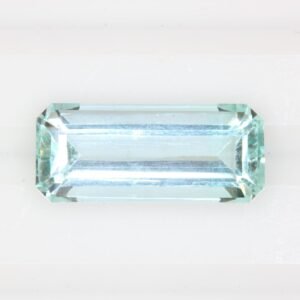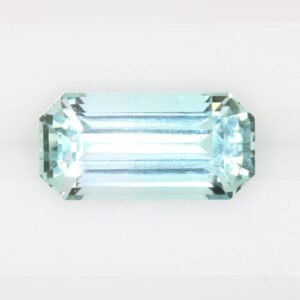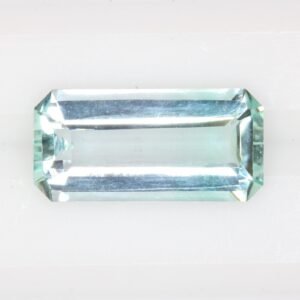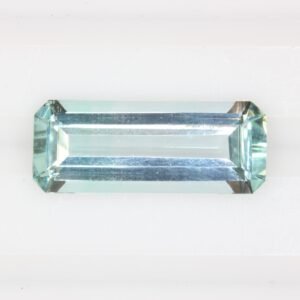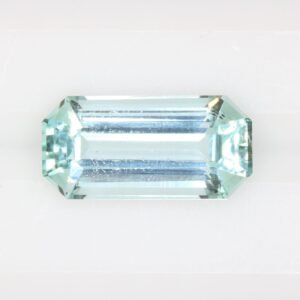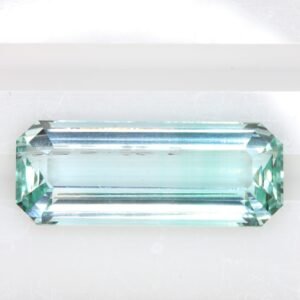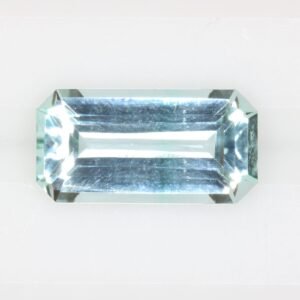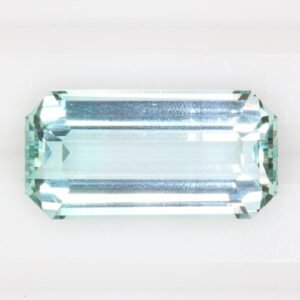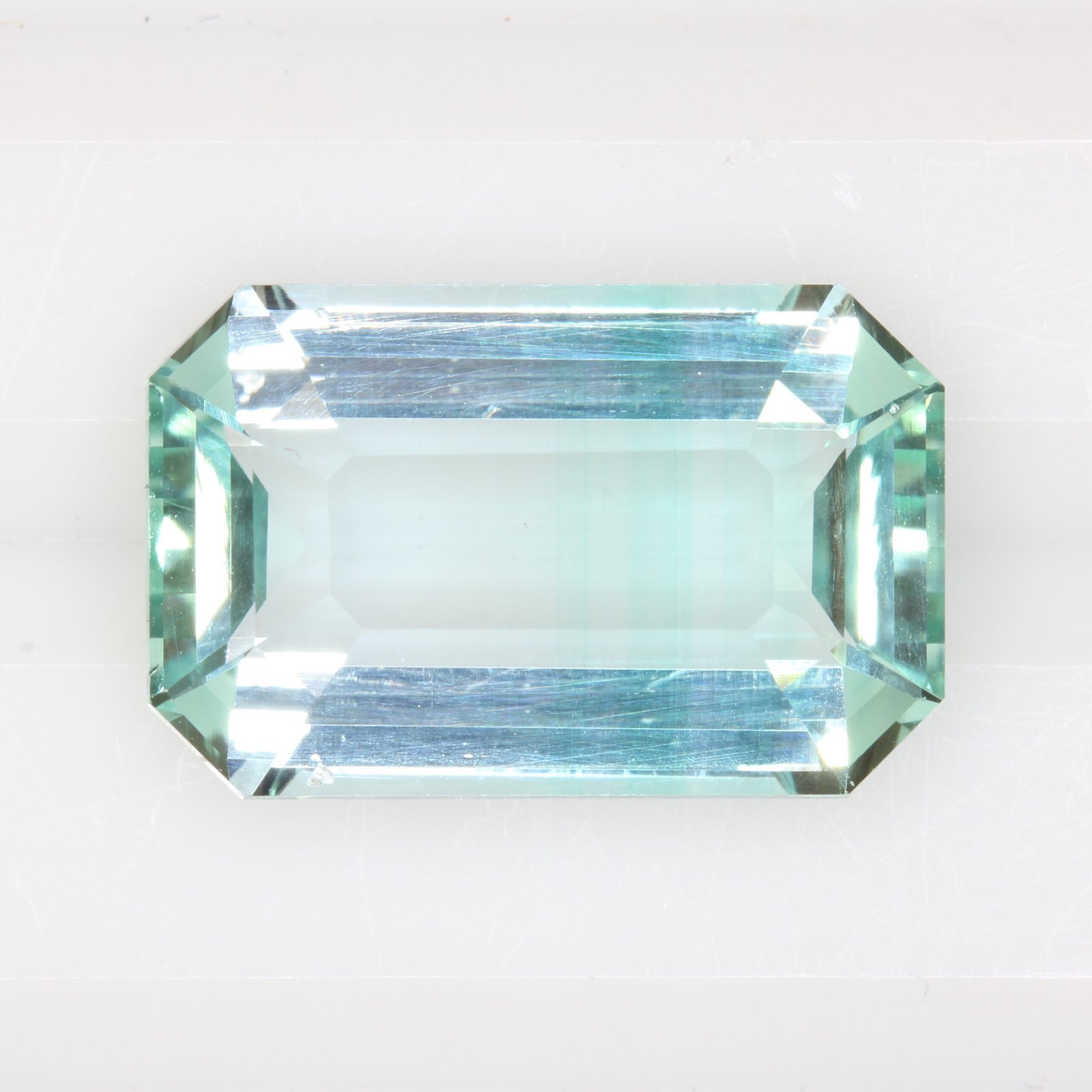
Green Aquamarine 5.28 cts
£380 (£72/ct)
In stock
| Weight | 5.28 carats |
|---|---|
| Dimensions | 14.25 × 9.18 × 5.38 mm |
| Gemstone type | Aquamarine |
| Colour | Green |
| Shape | Octagon |
| Treatment | Heat |
| Clarity | Eye Clean – VS |
| Cut | Good |
Green Aquamarine
Size: 14.25 x 9.18 x 5.38 mm
Colour: Sea form green
Shape: Octagon
Clarity: Eye Clean – VS
Cut: Good
Treatment: Heat
Aquamarine is the blue to blue green variety of beryl, the same mineral family that gives us emerald, morganite and heliodor. The name comes from the Latin aqua marina, meaning water of the sea, and the best material really does look like a piece of clear ocean held up to the light.
It is one of the few gemstones that is regularly available clean, well cut and in larger sizes, which makes it a favourite for statement rings, cocktail pieces and pendants where a big open stone is the whole point.
Every aquamarine in our collection is natural beryl, hand selected and cut in our own workshop in Hatton Wall, London.
Colour: from pale sky to deep Santa Maria blue
Colour is the single biggest driver of value in aquamarine. The range runs from a very pale, almost colourless sky blue through to a saturated, slightly steely deep blue.
Sea blue / light blue – the classic soft aquamarine look. Bright, fresh and easy to wear, and by far the most affordable end of the range.
Medium blue – the sweet spot for most buyers. Enough colour to read clearly as blue in daylight without the price jump of top material.
Santa Maria – a trade term for intense, deeply saturated blue, originally from the Santa Maria de Itabira mine in Minas Gerais, Brazil. Now used more loosely as a colour grade rather than a strict origin.
Santa Maria Africana – the same deep blue quality found in Mozambique and Nigeria.
Espirito Santo – a Brazilian trade name for a medium, slightly lighter but very clean blue.
Blue green / seafoam – stones that keep a natural green secondary hue. Unheated material often sits here, and it has a growing following among buyers who want something less uniform.
Aquamarine is pleochroic, meaning it shows different colours depending on the viewing direction, near colourless one way and blue the other. A cutter has to orient the rough carefully to get the strongest face up colour, and that orientation decision is often the difference between an average stone and a beautiful one.
Where aquamarine comes from
Brazil (Minas Gerais, Espirito Santo, Bahia) – the historic source and still the benchmark for fine colour.
Nigeria – strong saturated blues, often marketed as Santa Maria Africana.
Mozambique – excellent deep blue material in commercial quantities.
Madagascar – clean, bright stones across the colour range.
Zambia – slightly greener, very clean crystals.
Pakistan and Afghanistan (Shigar Valley, Nagar) – prized for sharp, gemmy crystals and fine light blue faceted stones.
Hardness, durability and everyday wear
Property Detail
Mineral Beryl
Mohs hardness 7.5 to 8
Refractive index 1.567 to 1.590
Specific gravity 2.68 to 2.74
Crystal system Hexagonal
Lustre Vitreous
Cleavage Indistinct, basal
At 7.5 to 8 on the Mohs scale, aquamarine is hard enough for daily wear in rings, pendants and earrings. It is harder than quartz, so it resists the everyday scratching that dulls softer stones. It does have some brittleness and an indistinct cleavage direction, so a sharp knock on a corner can chip it. Protective settings, bezels or slightly rounded corners are worth considering on a ring you plan to wear every day.
Clarity and inclusions
Aquamarine is a Type I gemstone, which means fine material is expected to be eye clean. Faceted stones with visible inclusions are generally lower value, with the exception of stones containing fine parallel hollow tubes. Those tubes are what produce cat’s eye aquamarine and, very rarely, star aquamarine when cut as a cabochon.
Heat treatment
Most aquamarine on the market is heat treated at low temperature, typically around 400 to 450°C. This removes the yellow component caused by iron and leaves a purer blue. The treatment is stable, permanent and universally accepted in the trade.
Untreated aquamarine keeps more of its natural green or teal secondary colour. Neither is better than the other, it comes down to what you like looking at. We state treatment status on every stone we list.
Cuts and shapes
Aquamarine’s clarity and large crystal size give a cutter room to work. Common shapes include:
Emerald cut and octagon, the classic aquamarine look, best for showing off clean colour
Oval, pear, cushion and round brilliants
Trilliant and kite shapes for bespoke settings
Cabochons, particularly for cat’s eye material
Concave, fantasy and freeform cuts for one off pieces
Because pale aquamarine can look washed out, cut quality matters more than usual. A well proportioned stone with a deeper pavilion holds colour far better than a shallow one, which is why two stones of the same weight and rough quality can look completely different.
Aquamarine as the March birthstone
Aquamarine is the birthstone for March and the traditional gift for a 19th wedding anniversary. It is also linked with Pisces and Aquarius. That makes it a popular choice for birthday gifts, engagement rings and anniversary commissions, and it is one of the few birthstones that suits almost every skin tone and metal colour.
Meaning and folklore
Sailors once carried aquamarine as a talisman for safe passage, believing it calmed rough seas. In crystal lore it is associated with clear communication, calm under pressure and emotional balance, and it is often chosen by people who speak or perform publicly. These are traditional beliefs rather than proven effects, but they are a large part of why the stone has stayed popular for thousands of years.
Aquamarine vs blue topaz, blue zircon and blue spinel
Buyers often compare these four. Blue topaz is almost always irradiated to achieve its colour and is far cheaper, with a slightly more electric, uniform blue. Blue zircon has much higher dispersion and a noticeable doubling of facet edges when viewed under magnification. Blue spinel is rarer and usually darker and more violet. Aquamarine sits apart for its soft, watery blue and its natural, untreated or lightly treated origin.
Caring for aquamarine
Clean with warm water, mild soap and a soft brush
Avoid ultrasonic and steam cleaners if the stone has liquid inclusions or surface reaching fractures
Keep away from prolonged high heat, which can alter the colour
Store separately from harder stones such as sapphire and diamond
Remove before swimming in chlorinated water or using household chemicals
Cutting, recutting and repolishing
We are a working lapidary as well as a gemstone dealer. If you have aquamarine rough, an inherited stone with chipped facets, or a piece that has gone dull with wear, we can facet, recut, repolish, drill or cut cabochons to order. Bring it to our workshop in Hatton Wall or post it to us via Special Delivery for us to assess.
Frequently asked questions
Is aquamarine a real gemstone? Yes. Aquamarine is a natural mineral, the blue variety of beryl, and has been mined and cut as a gemstone for thousands of years.
How much is aquamarine worth? Value is driven mainly by depth of colour, then clarity, cut quality and size. Pale commercial stones are very affordable, while fine deep blue Santa Maria material in larger sizes commands a significant premium.
Is aquamarine suitable for an engagement ring? Yes. At 7.5 to 8 on the Mohs scale it wears well. A protective setting is sensible for a stone that will be worn daily.
What is the difference between aquamarine and Santa Maria aquamarine? Santa Maria is a trade term describing an intense, deeply saturated blue. It began as a mine name in Brazil and is now used as a colour grade.
Is aquamarine heat treated? Most is, at low temperature, to remove yellow tones and leave a purer blue. The result is stable and permanent. Unheated stones tend to be greener or more teal.
Does aquamarine fade? Its colour is stable in normal light and everyday wear. Prolonged exposure to high heat should be avoided.
What month is aquamarine? March. It is also the gemstone for a 19th wedding anniversary.
Related products